e-Learning Beyond Blackboard
The introduction of learning management system (LMS or VLE for virtual learning environment) at City University of Hong Kong (CityU) was led by a small group of colleagues, including myself, in the Department of Physics and Materials Science and the Computing Server Centre (CSC) in 1998 [1]. Seven years after, unification of LMS was the main theme at the university wide deployment of Blackboard academic suite (Bb) [2]. When our staff and students could all enjoy a centralized platform to participate in e-learning, we heard students at other institutions complained about logging into different systems for different courses. The one and only “controlled” environment gained popularity - adoption rate leaped from 45% to 69% of all courses between 2004 and 2006. On the other hand, the world wide web (www) continues to evolve, so does the e-learning environment of a CityU student as illustrated in Figures 1* and 2* below.
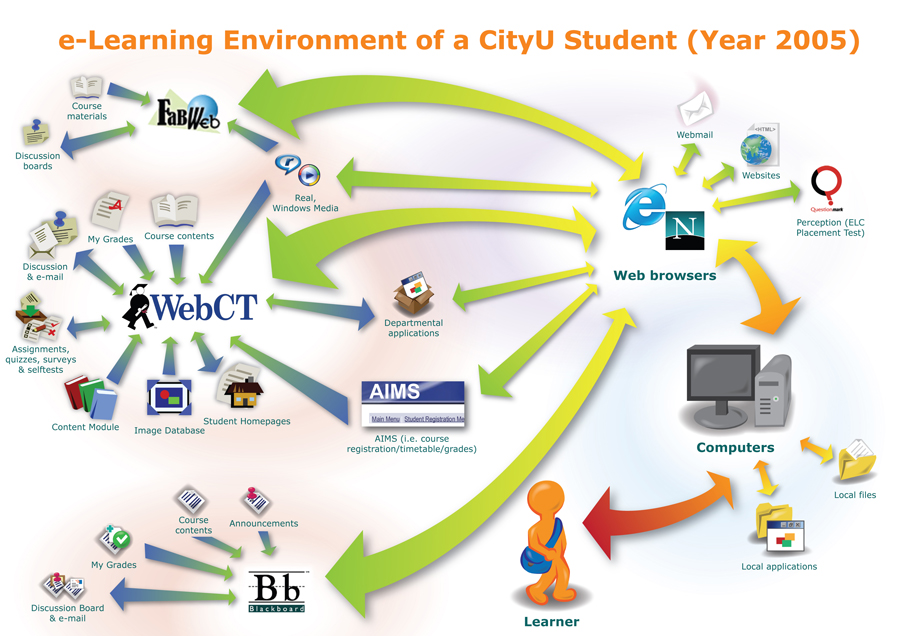
Figure 1
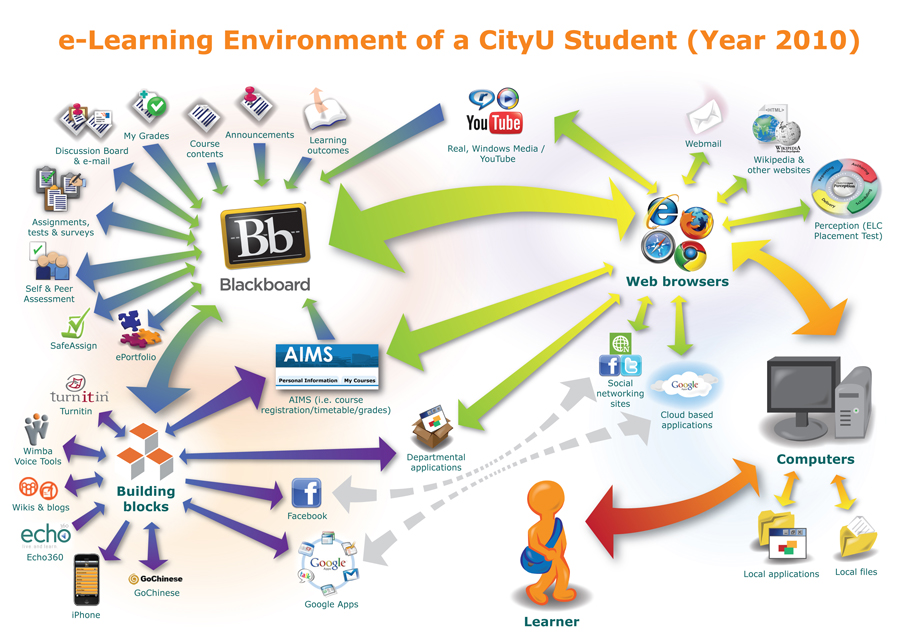
Figure 2
The arrows indicate the direction of information flow when a solid arrow pointing in both directions designates interactions (or information exchange).
Computers, including notebooks and netbooks, are indispensable when Personal Digital Assistants (PDA) do not survive the Hype cycle [3] (with smartphones as exception). Local files and applications (like MS Office) are still main stream but free online services gains popularity recently. With broadband connection, the access time of a local file and a Google document is comparable. Cloud based applications [4] effectively bounce web browsers to top of the chart in the local application hit list. Currently, Internet Explorer and Firefox are the core supported web browsers in e-learning. Some have voiced out the need to support Safari and Chrome and we try our best to test out web applications on more than two browsers.
For the purpose of e-learning, most of the time students connect to CityU’s Bb. The same as any LMS, Bb contains a standard set of tools in an authenticated area for teachers and students to engage in teaching and learning activities. With user data from the Administrative Information Management System (AIMS), course sites are prepared automatically one week in advance to the start of semester with the registered students and assigned teachers. Course instructors need not worry about student add/drop since the system update users daily according to the latest information on AIMS. Even some e-learning activists have criticized LMS (or VLE) for promoting a culture of dependency [5] or being a conservative technology [5], I still believe it is essential to adopt a centralized e-learning system. A public website can deliver notes to all web users effectively but the duty of a tertiary institution is to teach, summative assess, and then confer degrees to students accordingly. A centralized LMS not only provide a controlled environment but also shapes a platform and portal for additional tools and space. Hence, building blocks, based on the application programming interface (API) provided by Blackboard Inc., are purchased or developed to gain functionalities or connectivity of the system according to the needs. By the time this article is published, Google Apps should be launched as the next adjunct in CityU’s IT services with a building block to Bb named Bboogle.
A few years back, I found everyone launched his/her own blog and contributed to the Wikipedia all the sudden. When web technologist classified such “revolutionary” activities as Web2.0 [6], there might be more similarities than differences between a discussion forum and a wiki page. Nevertheless, Wikipedia became one of the most popular web sources for students to conduct “research” for their assignments when its value to higher education is undefined. Since the acceptance of Wikipedia to public (including our students) is simply inevitable, I hope colleagues could contribute more to make it more accountable. In addition, the concept of co-creation was reborn online with wiki. To facilitate co-creation exercises, Campus Pack wikis and blogs tools were acquired to integrate with Blackboard. In particular, the blog feature facilitated CityU students and online English tutors from around the world to participate in the Language Companion Course project [7] for two years.
How do I know students are sourcing Wikipedia for their assignment? Simply ask them to submit their work to Turnitin - the original plagiarism prevention solution. By comparing to current and archived www, research paper databases and student paper repository, the Turnitin Originality Report shows which parts of a student’s essay match other sources. After over four years of adoption at CityU, Turnitin now takes the role of improving student’s writing by alerting them improper “copy and paste” within their articles [8].
Studying Figure 2 piece by piece will be more fun than reading my explanation in words. Besides, the illustration will not be completely valid after a few months when more students shift to Google site for e-portfolio production. So how will the e-learning environment of a CityU student change in five years’ time? My guess is a lot but not significant to the point that Figure 2 looks alien. As long as the university runs in a traditional way of awarding qualifications, we will be bounded by certain rules and regulations to conduct education activities. Nevertheless, students will practice e-learning in more diversified and innovative ways with or without teachers’ leadership. It does not mean there is no role for teachers. According to my observation, digital natives [9] are very proficient in using apps but there is certainly room for development in data collection, information filtering and knowledge creation. Experiences from the digital immigrants [9] are vital to the success of the new generation.
*Note: the figures are inspired by a presentation by Niall Sclater, Director of Learning Innovation at The Open University of UK.
References
- Cheng, A. Y. S. & Wong, C. (1999). An Experience of Implementing Web-based Instruction Project at City University of Hong Kong. Proceeding of the Conference on Integrating IT & Teaching Development, Lingnan College, Hong Kong.
-
Wong, E., Wong, C. & Cheung, H. (2006). Adoption of e-Learning: From Organic to Planned. Proceeding of the 31st International Conference on Improving University Teaching (IUT), University of Otago, Dunedin, New Zealand.
-
Edwards, A. (2008). A Personal Learning Environment. http://www.intute.ac.uk/blog/2008/04/03/personal-learning-environment/
-
O’Reilly, T.: What Is Web 2.0. http://www.oreilly.com
-
Wong, C., Vrijmoed, L. & Wong, E. (2008). Learning Environment for Digital Natives - Web 2.0 Meets Globalization. In J. Fong, R. Kwan & F. L. Wang (Ed), Hybrid Learning and Education (pp. 168-177). Berlin / Heidelberg: Springer.
-
Davis, M. & Carroll, J. (2009). Formative feedback within plagiarism education: Is there a role for text-matching software? International Journal for Education Integrity, 5(2), pp.58-70. http://www.ojs.unisa.edu.au/index.php/IJEI/article/view/614/471
- Prensky, M. (2001). Digital Natives, Digital Immigrants. On the Horizon, 9(5). NCB University Press.