CityU WLAN Upgrade Project: An Update
The CityU WLAN upgrade project began in 2017 (Ref: Network Computing Issue 92 – June 2017?) and has been ongoing for more than two years. During this period, the outdated Aruba Wi-Fi system was replaced to support the 5th generation of Wi-Fi standard 802.11ac (Wi-Fi 5). Up until now the Computing Services Centre (CSC) has replaced more than 2,100 access points (AP) and the remaining ones are expected to be done by this summer.
Apart from the replacement of outdated APs, the CSC has also adopted the new server infrastructure and upgraded the ArubaOS to 8.3 to provide improved reliability, high availability and ease of operations. Below are some of the benefits of the new server infrastructure and ArubaOS:
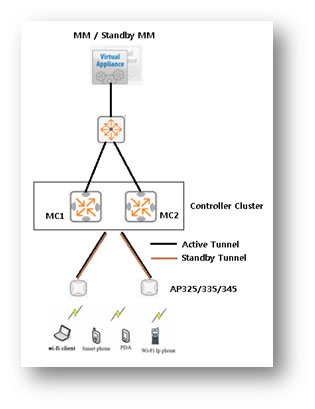
- Enhanced master functionality and new hierarchical configuration model. Mobility Master (MM) is introduced as the single point of configuration and image management. It provides centralised management for all the Mobility Controllers (MC) on the Wi-Fi network.
- Support virtualisation of the WLAN controllers (virtual Mobility Master and Mobility Controller) and enable us to utilise our existing virtualisation environment to achieve flexible deployment options. We can simply create another virtual controller, or add more CPU, memory, and storage to the existing controllers to accommodate increasing demands.
- Controller Clustering is introduced to form redundancy of controllers, resulting in hitless client failover. When a controller fails or a loss of connection is encountered, another controller in the cluster automatically picks up the access points and user sessions. Users will not notice any change on the network. Below is the simplified deployment model that is being used:
- The new AirMatch technology for centralised RF automation and client throughput optimisation provides better Wi-Fi experience in congested or dense environments such as lecture theatres and common areas.
- ClientMatch technology dynamically optimises client performance by enabling user devices to connect to the best AP available, thus enhances mobile experience.
- Live Upgrade feature enables real-time upgrade of the ArubaOS with no downtime and minimum impact to the user experience during the system upgrade.
- In-service upgrade feature allows us to update/upgrade service modules, such as AirMatch, ARM, etc. without the need to reboot the controller and hence users will not be interrupted during updates or while security patches are applied.
- Automatic load balancing of users across different controllers in the Controller Clustering are based on demands to prevent congestion on a single controller, thus providing better resource utilisation and improved network traffic throughput for each user.
- Provides API for application development to obtain data on device types, end user data, etc. We can also use the API to develop our own applications to enhance security and user experience.
What’s Next: Wi-Fi 6 (802.11ax)
Wi-Fi 6 is the next generation wireless standard that is specially designed for high-density areas and new access points/routers are available in the market now. It has many improvements over the Wi-Fi 5 such as delivering about 40 percent increase in throughput, and supporting full-duplex MU-MIMO technology to allow several clients to perform uploading and downloading simultaneously. Client devices are not yet available but will come to market soon. When they do, the CSC will conduct PoC tests and utilise Wi-Fi 6 to further improve our Wi-Fi service in the crowded areas.