A bugle call has been sounded for the reform of CityU's undergraduate education, as the march began last week in the University's battle to redraw its "AURORA" development strategy.
At the University Forum on 16 June, an audience of 150 staff and students heard a litany of recommendations on how to make our undergraduate education---which the President likened to the "bread and butter" of University work----shine even brighter in the years 2002-2007, and beyond. The suggestions were the result of full-day panel discussions on 15 June involving 100 academic staff who targeted their expert opinions at four critical and often intertwined areas: student intake quality, curriculum, learning and assessment, and out-of-classroom experiences.
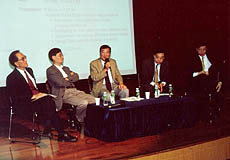
These discussions culminated in a University Forum on Undergraduate Education Saturday morning, with the four panels reporting their findings and recommendations before discussions were open to the floor.
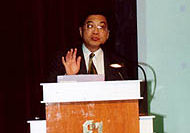
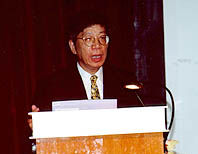
At the University Forum,
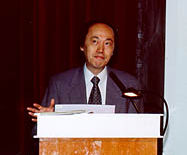
Professor Edmond Ko, Vice-President for Education, said the three-day gathering on educational issues, organized with the help of the
Registrar's Office, was meant to kick off a long consultation and planning process for the University's AURORA II strategy. The present AURORA will cover various initiatives until early 2002. In order to forge ahead and achieve its stated mission, the University has initiated a new planning process for AURORA II, which will chart the University's course through year 2007 and beyond.
Invited to address the gathering before and after staff discussions, the President set down the parameters of the planning and discussion process. On 14 June, according to Professor Ko, the President told staff that:
CityU's current round of strategic planning should go beyond the requirements and expectations of the HKSAR government.
We should look at ways to prepare our graduates for a rapidly changing world
We should train better students and develop their self-confidence.
The University should encourage the assessment of staff scholarship in multiple dimensions.
What is a research university in Hong Kong and how does CityU fit in? How can the University strike a healthy balance between research and teaching?
At the Forum's start, Professor Ko said he was impressed by the quality of the panel discussions Friday. "The exchanges were constructive in nature and collegial in spirit," he said, "and what's more outstanding is that people focussed on the issues at a strategic level." In the ensuing 90 minutes, the four panel convenors took turns to present perhaps the largest collection of staff-inspired ideas so far on raising the University's educational quality.
On the question of improving student intake,
Professor Richard Ho, Dean of
Faculty of Business, said his group suggested, among other things, that the University:
Identify unique programs and "star" professors and repackage them with greater marketing flair;
Diversify the sources of our student intake by, for example, recruiting more non-local students (from Pearl River Delta region in South China), international school students in Hong Kong and international students from Southeast Asia and the like;
Improve articulation opportunities for Higher Diploma/Associate Degree graduates into bachelor degree programs.
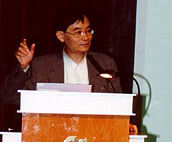
On revamping the undergraduate curriculum, Professor Matthew Chen, Dean of
Faculty of Humanities and Social Sciences, said his group recommended, in principle, to cut down on credit requirements for programme core and electives so that students will have more room to choose their own "free electives." "Our current curriculum structure stands in the way of broadening students' educational experience," he said. His group suggested the 60 credit units now required for program cores and electives be cut back to 36 to 45 credits, in addition to taking measures to beef up the educational value of out-of-discipline courses. Curriculum design should also be more flexible in accommodating the needs of minors and double majors. "Our current credit unit system lives in name only," he said, "a true credit unit system should promote and encourage students' free enquiry of knowledge, with maximum flexibility in duration and study mode." Lastly, he pointed out that the Chinese Civilization Course, a great idea in itself, is often seen by students as "an add-on requirement" not integrated with their programmes. Besides, he added, the
Chinese Civilisation Centre also suffers from "the lack of support from an infrastructure", meaning there is an absence of a history or philosophy department on campus.
On the issue of learning and assessment,
Professor Roderick Wong, Dean of
Faculty of Science and Engineering, said his group suggested that:
-
More experience sharing sessions among staff on teaching should be encouraged at the departmental level, in the forms of occasional seminars and appointment of mentors to junioracademic staff;
-
The Teaching Feedback Questionnaire should be required but supplemented by peer reviews;
-
English should be enforced as the medium of instruction;
-
CityU should position itself as an IT university, with, for example, all of its course materials be available on the Web;
-
Students should be made aware of their responsibility in learning;
A hands-on approach to learning, including problem-based learning, internships and placements, is more effective and should be encouraged;
-
Less weightings for final examinations and more continuous assessments during term time;
-
Faculty examination boards to reconstituted for greater administrative efficiency;
-
External examiners and departmental advisory committee be made optional.
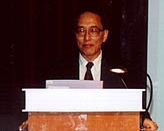
Finally, Professor H K Wong, Principal of the
College of Higher Vocational Studies, talked about out-of-classroom experiences and CityU's strengths and weaknesses in this area. His group found that even though CityU is committed to a total and seamless educational approach with emphasis on students' whole-person development, the participation rate among students in extra-curricular and life-wide learning acitivities and experiences is still low. Limited space and lack of residential facilities are one set of shortcomings to be overcome, inadequate motivation among staff and students are the other. He raised the questions of whether out-of-class learning and situations should be credit-bearing and recorded on transcripts.
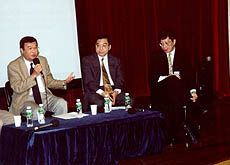
The hour-long Q&A session, moderated by
Professor Y S Wong, Vice-President for Institutional Advancement, drew an enthusiastic response from staff and students. Staff members focused their concerns on the length of university education, the value of departmental sharing sessions on teaching, recruiting non-local and international students, and the value of out-of-discipline courses. Students, meanwhile, questioned whether tuition fees based on credit units would limit students' choices to vocational-oriented courses.
In conclusion, the President said he was encouraged by the recommendations from the four panels. The University community will have further opportunities to discuss these in the next three to four months before the proposals are put forward for the Management Board's deliberation. He told staff that "we are moving in the right direction", that although the University's work is supported by society, CityU must focus on improving curriculum and teacher-student interactions.