Q & A with Mr Joseph Chan
Shiona Mackenzie
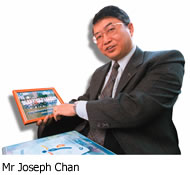
Mr Joseph K N Chan, Acting Director, Student Development Services (SDS), is responsible for personal counselling,
CityU stands with universities such as Cornell, St Mary’s
Why is “whole person development” (WPD) among CityU’s values today?
Technically, the idea was incorporated into the CityU strategic plan in 1997 and, in support of this, the Student Affairs Office was re-christened “Student Development Services”. Conceptually, this is a tradition of Chinese educational philosophy. We maintain that a person is a “person” first, before he is an “intellectual” or even a “professional”. To quote
Practically speaking, in high school, students do spend a great deal of time memorizing facts and studying for exams, often at the expense of personal development. In a way, our whole person development notion is a measure that nurtures aspects of a student that may not have received sufficient attention yet, as well as an orientation to the demands of society. Whole person development programmes give some students a second chance at succeeding in higher education and in life; many of CityU’s academics support this.
How does the SDS promote WPD, and who is involved?
We started with a committee that formulated three operating principles, and tailored different programmes for specific groups of students. First, we run campus-wide award schemes, encouraging students to take part in activities and programmes related to the concept of whole person development, either inside or outside the institution. The students are put in charge. After fulfilling certain requirements, they will have earned a medal, and can shake hands with the President. It does resemble, in a way, the Duke of Edinburgh Awards in the
“Project Star” is a campus-wide leadership programme with a simple concept. First, 100 students go to a training camp, either on campus, or at another site; next, they design their leadership courses from a menu; finally, they perform community service, which must be related to leadership. For example, they can organize a leadership workshop here, or at their own secondary school. That means they can put into practice what they’ve learned. At the end of the year, we select 20 of these students to organize a leadership conference for about 200 young people from
Second, through other programmes, we promote the concept of WPD to target groups. In the guide, On Your Way to Excellence, the concept is made clear to new students. The booklet introduces them to managing their learning, communication skills, direction in life, time, interpersonal relationships, career, health and fitness--it’s quite comprehensive.

Annually, we get about 500 first year students joining our WPD Award Scheme; altogether we have around 1,500 students enrolled and actively engaged in our self-development programmes in any given year. Still more participate without aiming for an award. For our university athletes, we offer a special programme to help them with their studies, develop leadership skills, learn how to handle stress and motivate themselves. So, they can expand their horizons.
Third, on another level, we cooperate a lot with academics that run their own programmes. The Industrial Attachment Scheme, for instance, has proved extremely successful and is highly regarded by students. There’s nothing like practical experience to help a person grow. Plus, campus-wide, the University has instituted the Chinese Civilisation Centre, which helps students discover their roots, and establish their identity. Also out-of-discipline courses contribute to their balanced development, (for instance, science students are exposed to the humanities, and vice versa).
What does WPD mean for disabled and non-local students on campus?
All the existing programmes are available to them in English, Putonghua and Cantonese. We also have a “buddy scheme” which comprises students who get cross-cultural communication training, and then they run orientation programmes and befriend the non-local students. Disabled students can take advantage of “peer counselors” who run workshops for them. We like to involve their parents as well, because they often need continuing support at home. Our campus is, nowadays, quite well-equipped now to meet the needs of people with special needs. We even offer helpful programmes for students about to embark on exchange programmes. Counselling is available; most SDS staff members hold humanities and/or psychology qualifications, and we encourage staff development, too. We conscientiously support them updating their skills.
How is WPD part of your life, personally?
I try to practise what I preach! While I have a liberal education in university, I also play guitar, enjoy classical music, sing in a choir, and read humanities and social sciences books. I am also the manager of our student soccer team. Ultimately, WPD is a humanitarian concern, both personal and universal, isn’t it? I believe WPD means putting “people” in their rightful place in life—technology was meant to serve people; not the other way round. Face-to-face interaction is still the ultimate influence on a person in higher education and student development.
What difference does WPD make to the community, or to
SDS serves the community by sharing student development and WPD experiences with colleagues in
As Acting Director, how do you see WPD in action from 2004 onwards?
First, our academic colleagues have taken the lead in providing development opportunities for students, and we will continue to support that whole-heartedly. Secondly, we want to revitalize our student body—we want them to understand their role and do things related to their charter. Of course, socializing is good, but we don’t want their responsibilities to get overlooked. Thirdly, for our part, we are going to focus more on student ‘learning’, not simply to pass tests, but to use in their everyday lives.
This story appears in CityUToday Issue No. 1