Breakthrough in making solar cells more efficient, scalable, and ‘green’
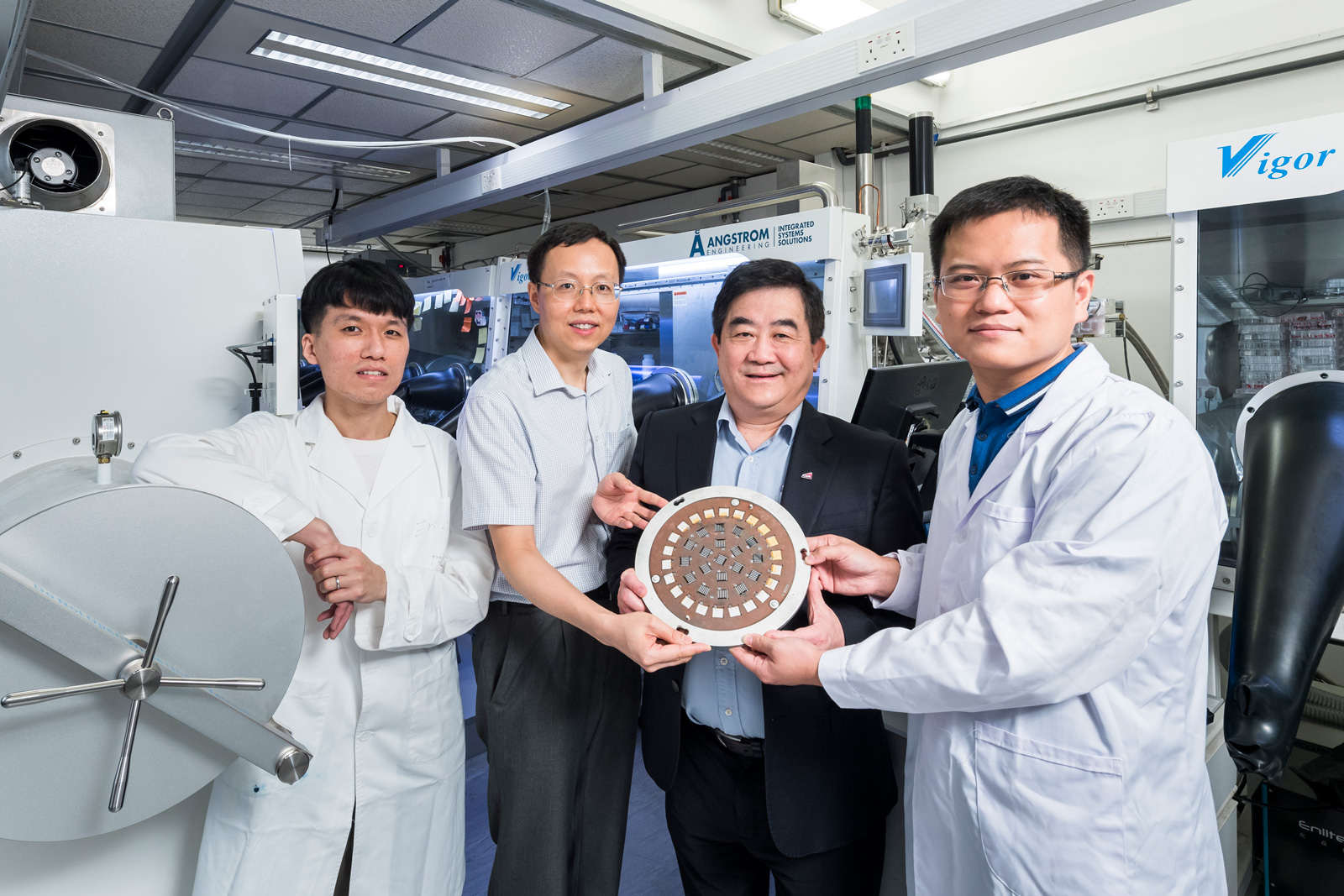
A research team led by scientists at City University of Hong Kong (CityU) has discovered an exciting new way to make solar power more effective and more environmentally friendly.
The breakthrough concerns the use of a new metal-organic framework that not only improves operational stability but also contains the lead that can potentially leak from perovskite solar cells.
While it is well known that solar power has registered significant growth as a reliable source of renewable energy in recent years, and that the power conversion efficiency registered for organic-inorganic lead halide perovskite solar cells (PVSCs) is growing higher than that of silicon solar cells, the increased production and use of PVSCs can be harmful to the environment due to lead leakage.
The CityU research team has come up with a possible long-term solution. A ground-breaking 2D conjugated metal-organic framework (2D MOF), which involved a year-long experiment, could be applied to modern PVSCs, making way for a commercially viable, large-scale deployment of the technology.
Professor Alex Jen Kwan-yue, Provost and Chair Professor of Chemistry and Materials Science, said the research outcomes suggested improved sustainability, good operational stability and enhanced power conversion efficiency (PCE).
The production of PVSCs involves the application of layers of different materials, with the new MOF the last layer to be applied. This new layer is the focus for making the solar cells less harmful.
“The new functionalised MOF can capture toxic lead ions that could leak over time because of device degradation. The captured lead ions will form an insoluble substance that is not a contaminating agent,” Professor Jen said.

In addition, experiments under accelerated testing conditions have revealed the excellent thermal stability and good performance of PVSCs after prolonged exposure to external elements in controlled conditions.
But the newly developed MOF is more than a protective layer. It is a multi-functional material that acts as an active electron-extraction layer at the perovskite/cathode interface, allowing the layer to play a contributory role in converting sunlight into electricity.
“Most of the existing protective layers used in the PVSCs do not come with the characteristics of a semiconductor, therefore playing little role in raising efficiency,” said Professor Xu Zhengtao of the Department of Chemistry (CHEM), adding that the newly discovered characteristics of the MOF were an efficient charge-transporting layer.
One of the reasons for the high PCE of the new MOF is the elevated fill factor, resulting from enhanced electron extraction capability derived from the newly experimented component.
“The multi-layer construction of PVSCs implies certainty related to charge loss between layers,” explained Dr Zhu Zonglong, Assistant Professor in CHEM and in the Department of Materials Science and Engineering (MSE). “The square shape of the current-voltage curve ensures the best possible known fill factor to feature an elevated PCE compared to existing systems.”
The breakthrough research titled “2D Metal-Organic Framework for Stable Perovskite Solar Cells with Minimized Lead Leakage” has been published in the coveted scientific journal Nature Nanotechnology.
The other contributors to the project were Wu Shengfan, first author and PhD student in CHEM, and researchers from CHEM and MSE, Xi'an Jiaotong University, University of Washington, and University of California-Irvine.