Untangling the mystery of quantum entanglement
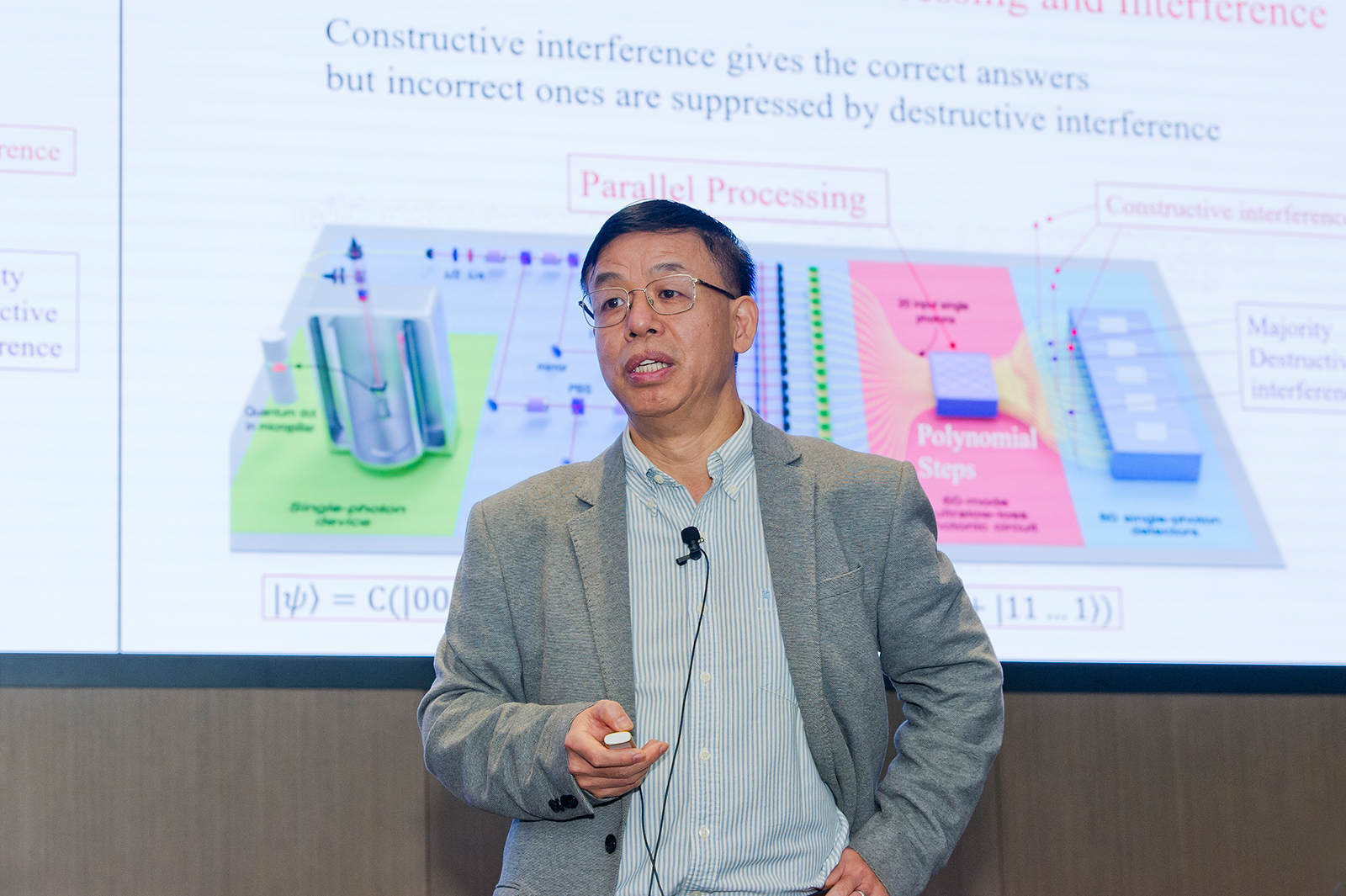
In this timely talk, Professor Jeff Ou Zheyu, Chair Professor in the Department of Physics at City University of Hong Kong (CityU) and a leading expert in quantum optics, unveiled the mystery of quantum entanglement by interpreting the work of last year’s winners of the Nobel Prize in Physics and presenting perspectives for potential applications in the second quantum revolution.
Professor Ou was speaking at the President's Lecture Series: Excellence in Academia on 11 January, and his talk was titled “Untangling the Mystery of Quantum Entanglement”.
Quantum entanglement refers to the mind-boggling phenomenon of two particles being linked together despite galactic volumes of interstellar space separating them.
This topic has set campus buzzing of late because of CityU’s close associations with two of last year’s winners of the Nobel Prize in Physics: Professor Alain Aspect, Senior Fellow at the Hong Kong Institute for Advanced Study at CityU, and Professor Anton Zeilinger, Austrian Academy of Sciences, who was a featured speaker at the HK Tech Forum titled “Quantum Physics and Complex Systems” in December 2022.
These groundbreaking scholars have pioneered research that has helped prove the bizarre theory of quantum entanglement.
“Quantum entanglement is an elusive idea for the general public but a fundamental concept in physics,” said Professor Ou.
In his talk, Professor Ou, one of the world’s most influential scholars in quantum sensing and metrology, quantum state engineering, and more fundamental quantum interference and quantum measurement processes, discussed how Einstein and others introduced the concept of quantum entanglement to argue against modern quantum physics.
“Einstein’s view was that physical quantity has to be certain. If there is uncertainty, that is not because it is unreal but because of our inability to know. It is there but beyond our ability to know it,” explained Professor Ou.
However, subsequent research, including that of Professor Ou, in particular his work on the Hong–Ou–Mandel effect in quantum optics, has demonstrated that, as “spooky” as it might seem, quantum entanglement is real.
“Subsequent development in theory and experimental tests confirmed the mind-boggling quantum concept but, in the meantime, also laid out the foundation for the second quantum revolution that promises to bring disruptive and transformative technological innovation in computing, secure communication, and sensing applications,” said Professor Ou.
This technological revolution has incredible implications for quantum computing, communication, sensors, and even teleportation! But we are far from achieving many of these technologies.
“Quantum systems are hard to build,” explained Professor Ou, adding that inherent conflicts are embedded in such endeavours. On the one hand, quantum systems must be isolated to become quantum but at the same time they need to be both interactive for information processing and operational on a large, macroscopic scale.
Despite these hurdles, he is excited about future prospects.
“We can take advantage of quantum entanglement. Quantum technologies show great promise!” he said.
Professor Ou received his BSc degree from Peking University and PhD from the University of Rochester, New York. He is a Fellow of the American Physical Society and Optica (formerly the Optical Society of America).