World’s first experimental observation of a Kondo cloud
Physicists have been trying to observe the quantum phenomenon Kondo cloud for many decades. An international research team comprising a scientist from City University of Hong Kong (CityU) has recently developed a novel device that successfully measures the length of the Kondo cloud and even allows for controlling the Kondo cloud. The findings can be regarded as a milestone in condensed matter physics and may provide insights for understanding the multiple impurity systems, such as high-temperature superconductors.
Dr Ivan Valerievich Borzenets, Assistant Professor at CityU’s Department of Physics, collaborated with scientists from Germany, Japan, and Korea on achieving this breakthrough. Their research findings were published in the latest issue of the highly prestigious scientific journal Nature, titled “Observation of the Kondo Screening Cloud”.
What is the Kondo cloud?
Kondo effect is a physical phenomenon discovered in the 1930s. In metals, as the temperature drops, electrical resistance usually drops. However, if there are some magnetic impurities in the metal, it will show the opposite result. Resistance will drop at first. But when it is below some threshold temperature, the resistance will increase as the temperature decreases further.
This puzzle was solved by Jun Kondo, a Japanese theoretical physicist over 50 years ago and hence the effect was named after him. He explained that when a magnetic atom (an impurity) is placed inside a metal, it has a spin. But instead of just coupling with one electron to form a pair of spin-up and spin-down, it couples collectively with all the electrons within some areas around it, forming a cloud of electrons surrounding the impurity. And this is called the Kondo cloud. So when a voltage is applied over it, the electrons are not free to move or are screened off by the Kondo cloud, resulting in resistance increase.
How big is the cloud?
Some basic properties of the Kondo effect have been proved experimentally and were found related to the Kondo temperature (the threshold temperature where the resistance starts to go up at low temperature). However, the measurement of Kondo cloud’s length was yet to be achieved. Theoretically, the Kondo cloud can spread out over several micrometres from the impurity in semiconductors.
“The difficulty in detecting the Kondo cloud lies in the fact that measuring spin correlation in the Kondo effect requires the fast detection of tens of gigahertz. And you cannot freeze time to observe and measure each of the individual electrons,” explained Dr Borzenets, who performed the experimental measurement of this research. Being a researcher who enjoys conducting complicated experiments, he decided to take up this challenge.
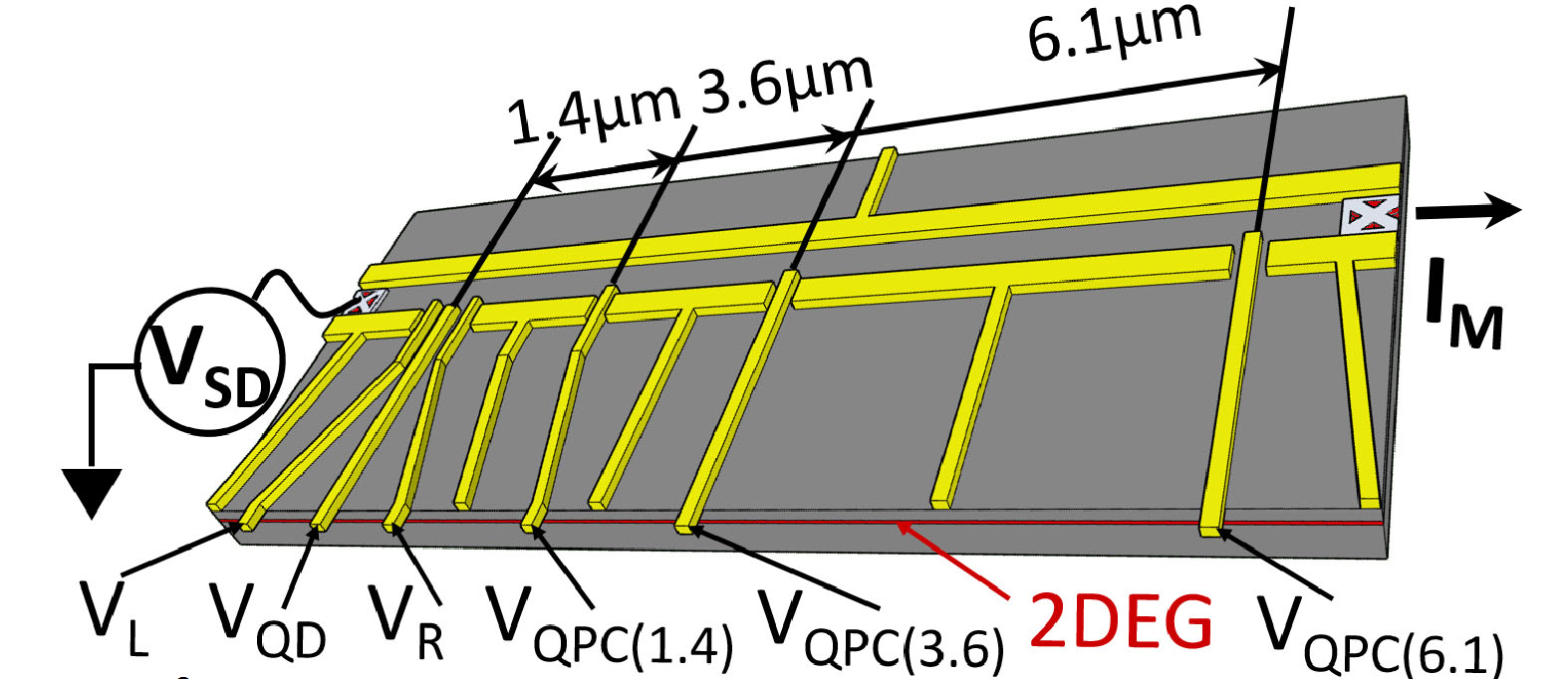
Isolating a single Kondo cloud in the device
Thanks to the advance in nanotechnology, the research team fabricated a device that can confine an unpaired electron spin (magnetic impurity) in a quantum dot, like a small conducting island with a diameter of only a few hundred nanometres. “Since the quantum dot is very small, you can know exactly where the impurity is,” said Dr Borzenets.
Connecting to the quantum dot is a one-dimensional and long channel. The unpaired electron is constricted to couple to the electrons in this channel and form a Kondo cloud there. “In this way, we isolate a single Kondo cloud around a single impurity, and we can control the size of the cloud as well,” he explained.
The novelty of the system is that by applying a voltage at different points inside the channel with various distances away from the quantum dot, they induced “weak barriers” along the channel. Researchers then observed the resulting change in electron flow and the Kondo effect with varying barrier strength and position.

The secret lies in the oscillation amplitude
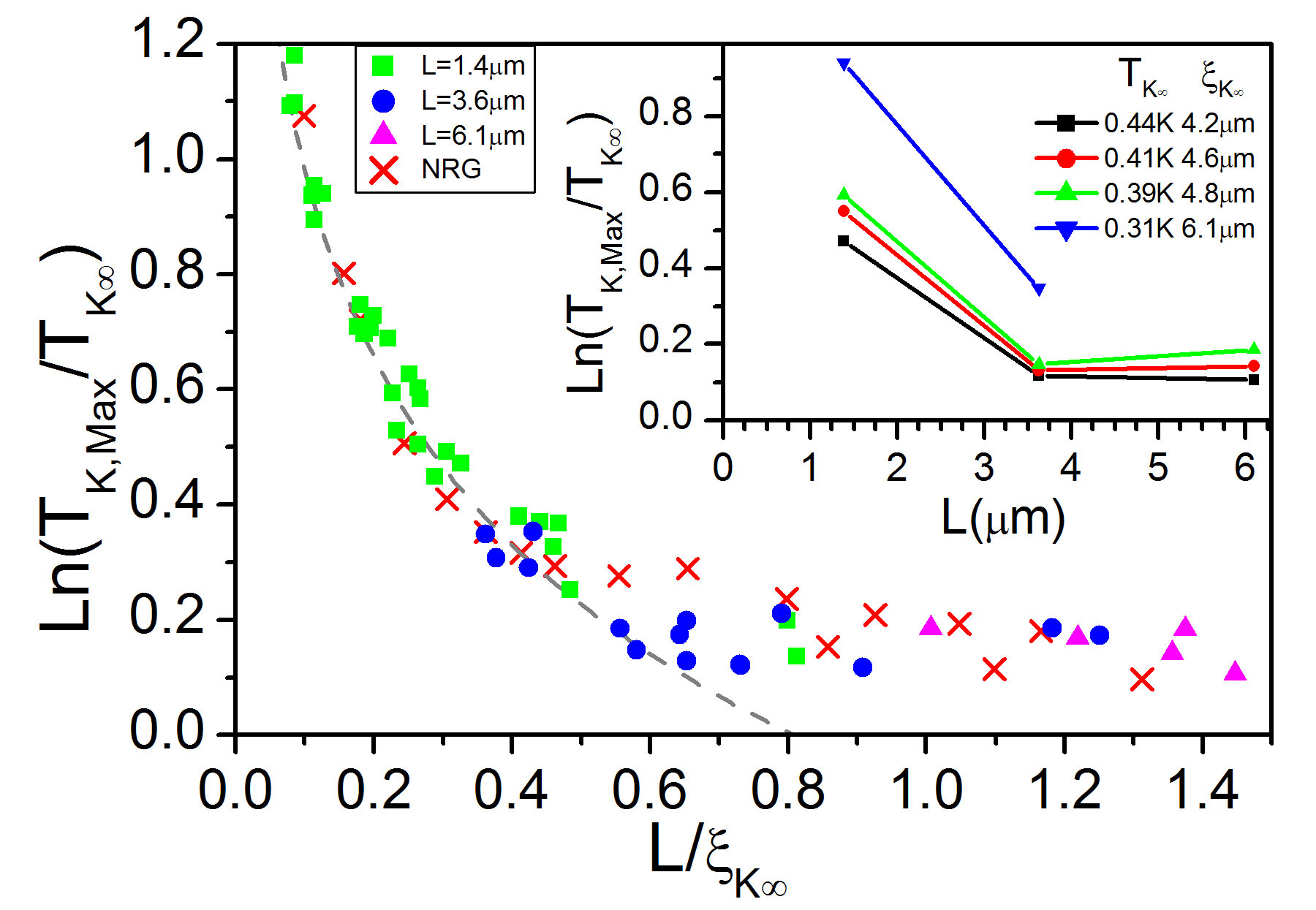
By changing the voltages, it was found that the conductance went up and down, no matter where they put the barriers at. And when there were oscillations in conductance, oscillations in the measured Kondo temperature were observed.
When the researchers plotted the oscillation amplitude of Kondo temperature versus the barrier distance from the impurity divided by the theoretical cloud length, they found that all their data points fall onto a single curve, as theoretically expected. “We have experimentally confirmed the original theoretical result of the Kondo cloud length which is in micrometre scale,” said Dr Borzenets. “For the first time, we have proved the existence of the cloud by directly measuring the Kondo cloud length. And we found out the proportionality factor connecting the size of the Kondo cloud and Kondo temperature.”

Provide insights into multiple impurity systems
The team spent almost three years in this research. Their next step is to investigate different ways to control the Kondo state. “Many other manipulations on the device can be done. For example, we can use two impurities at the same time and see how they will react when the clouds overlap. We hope the findings can provide insights into the understanding of multiple impurity systems such as Kondo lattices, spin glasses, and high transition-temperature superconductors.”
Dr Borzenets, Professor Sim Heung-Sun from Korea Advanced Institute of Science and Technology (KAIST) and Dr Michihisa Yamamoto of RIKEN Center for Emergent Matter Science (CEMS) in Japan are the corresponding authors of the paper. Dr Borzenets and Dr Shim Jeongmin from KAIST are the co-first authors. Other co-authors included Jason Chen C. H. from the University of Tokyo, Professor Dr Andreas D. Wieck and Dr Arne Ludwig from Ruhr-University Bochum, as well as Professor Seigo Tarucha from RIKEN CEMS.
The study was supported by CityU, Hong Kong Research Grants Council, Grants-in-Aid for Scientific Research (KAKENHI), Japan Science and Technology Agency and the National Research Foundation of Korea.
DOI number: 10.1038/s41586-020-2058-6