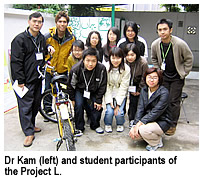
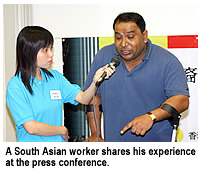
A group of 24 social work students from CityU launched a press conference on 13 June to call attention on the issue of labour rights among South Asian people in
Hong Kong. Together with
Dr Kam Ping Kwong, Associate Professor of the
Department of Applied Social Studies (SS), they formed a Working Group of the Community Concern Project on the Protection of Labour Rights among South Asian People in
Hong Kong (Project L), an out-of-classroom learning experience led by Dr Kam.
Project L is a continuation of the Social Integration Project for Ethnic Minority People in Hong Kong (Project S), also an out-of-classroom learning experience for another group of CityU social work students last year, to explore the situation of social exclusion among South Asian people in Hong Kong. This year, Project L continues the same theme with a sharper focus: knowledge and attitude about labour right, or the lack of it among the minority community of South Asians in Hong Kong. Sponsored by the SS department's Maximizing Students’ Learning Activity Fund, both projects have been jointly conducted with the Unison Hong Kong – For Ethnic Equality, founded by alumna Ms Fermi Wong.
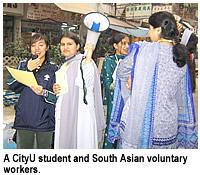
A core task of the project is a survey of some 400 South Asian people selected by convenient sampling, conducted from12 March to 3 April. A structured and closed-end questionnaire has been designed, based on ideas generated through focus groups and home visits to South Asian people. To help CityU students overcome the language barrier problem during the process of interview, some 20 South Asian students from Delia Memorial School (Hip Wo) were recruited as translators. Training workshops were provided to equip interviewers and the South Asian students with knowledge of labour ordinances, and interviewing skills. Data was collected through street interviews, home visits, and interviews conducted in mosques and schools, mainly in the districts of Wanchai, Jordan, Kwai Chung, Tuen Mun and Yuen Long.
A self-empowering learning experience
Apart from advancing the labor rights for South Asian people, the project also turns out to be a learning experience of self- empowerment for participating students. “I find myself more confident speaking in English now,” said student Mr Jackie Ip, who plays a major role in liaising with Delia Memorial School to recruit South Asian student helpers. Running workshops to help equip secondary students with knowledge of labour ordinance gives him the opportunity to conduct training in English. He also applied what he has learned in theory on action research and acquired a deeper understanding of the culture of ethnic minority groups in Hong Kong.
Thanks to acting as Convenor in group meetings and conducting street interviews, SS student Miss Jessica Lam found that her interpersonal and communication skills were enhanced. The project gave her insight to the plight of South Asians working in Hong Kong: some do not know English and thus have no access to information on their rights as workers.
Miss Esther Tsang, another participating SS student, learned the merits of acceptance and tolerance of cultural differences. Taking part in the project has changed her perception of South Asian people for the better. "I was surprised to find that they were so nice and approachable, just like any of us," she said. "They are also residents in Hong Kong with valid ID cards. They should not be treated as outsiders who compete for jobs with the locals."
Major research findings and recommendations
A total of 403 Nepalese, Pakistanis and Indians were interviewed in the Working Group’s survey. Most of them were male, 21 to 40 years of age, and 70% claimed that they are permanent residents. Only half of them held full-time jobs. The population of South Asian people in
Hong Kong is about 42,000. According to the survey findings, the labour rights of South Asian people are not adequately protected in
Hong Kong. South Asian workers report that their labour rights are less protected than those of 'local' workers. They regularly encounter difficulties in getting information about labour ordinances, such as a language barrier, inadequate effort on the part of the Government to provide them with information, lack of public education, and lack of channels for South Asian people to seek help.
The study recommends that the Government: speeds up the drafting of the law against racial discrimination; provides translation of labour ordinances into South Asian languages; and sets up special service counters in the Labour Department for South Asian people.