Harvard academic opens up discussions on general education
Michael Gibb
| An international expert in curriculum reform 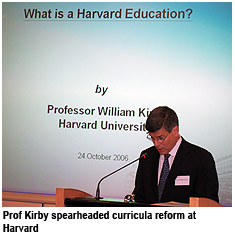
from Harvard University kicked off a series of seminars this week at City University of Hong Kong (CityU) aimed at driving forward plans for the general education component of the University’s new four-year degree structure.
Professor William C Kirby, the former Dean of the Faculty of Arts and Sciences at Harvard and now the Geisinger Professor of History and the Director of the Fairbank Center for East Asian Research at Harvard, discussed his experience of curriculum reform and his thoughts on general education at a meeting on 24 October.
Professor Kirby is already well known on campus. CityU benchmarked the design of general education curriculum that was submitted to the University Grants Committee in May 2006 against curricula reforms conducted at Harvard.
Professor Kirby in his role as Dean co-chaired a Committee on General Education in 2004 in order “to develop a proposal for the structure of requirements in general education and a mechanism for determining which courses will satisfy these requirements”.
Professor Kirby’s talk thus proved timely since CityU is currently pro-actively engaged in setting out a comprehensive blueprint for its new curriculum, which is to be implemented in 2012. This innovative programme of study will nurture "ideal graduates" via a balanced education that requires students to take a minimum of 30 credits in general education on top of their major, minor and elective subjects.
In his welcoming address, Professor Richard Ho Yan-ki, Vice-President (Undergraduate Education) said CityU would launch some general education courses next year based on recommendations put forward by the CityU’s General Education Committee.
“We are entering into a very interesting phase of world economic development and the world that the next generation will be entering will be quite different from what we are used to,” Professor Ho said, highlighting the need to broaden students’ horizons and encourage life-long learning and a greater appreciation of cultural diversity.
In his wide-ranging lecture, Professor Kirby, a renowned historian of modern Chinese history, returned to a key point several times, that “one-size-fits-all” curriculum did not exist.
“We don’t and never have believed [at Harvard] that there is one path to education, and we have always believed that students need to have the capacity to make choices from among the many opportunities the faculty provides,” he said.
A regular review of any curriculum was vital, he said, to ensure a place of learning was providing an education that matched the needs to the students, and any reform had to have the full backing of the teaching staff in the faculties.
“The curriculum has to be one that the faculty has the possibility of creating itself and making it its own and therefore of having the esprit de corps of transmitting it through good teaching. Creativity and energy comes from the deep involvement of faculty,” he said.
Although CityU and Harvard differ in their respective roles within higher education, according to the Harvard academic, they are united in their affirmation that the role of general education is to connect students with what they learn in university to life outside the classroom.
“Education exists not just to train individuals for a very specific career, but also to teach them to be curious, reflective and skeptical,” he added.
Professor Kirby’s talk was followed by a lively Q&A in which questions were asked about the comparisons between major universities in the region with Harvard; the characteristics of Hong Kong students; the organization of teaching and learning in general education at Harvard in terms of class sized and the use of technology; and whether research suggested general education has the desired impact.
On the last point, Professor Kirby said although he did not have hard numerical evidence, CEOs often claimed they sought out smart students who could solve problems, think and argue, express themselves in writing and orally, work well in teams, possessed enquiring minds and were broadly educated and who read, all of which are prominent features in general education.
“After all,” he concluded, “continuing education is what we are all after at the end of the day.”
|