Building a quality university: VP(AA) speaks his mind
Regina Lau
One of the results of the senior management reshuffle implemented by President H K Chang in December last year was the creation of a new position of Vice-President for Academic Affairs. The position is charged with overseeing both teaching and research activities throughout the University.
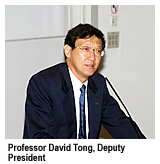
“For most of my career, I have had duties as a teacher, researcher and administrator,” said Professor Tong. He was Head of the Physics Department at the
“You get relatively quick and visible results in teaching and research from the feedback of students and the papers you write,” Professor Tong said. “But in administration, it is very difficult to get immediate results. This is especially true in higher education, where almost everything we do is a long-term investment. What's important is to be steadfast in your values and principles, seek opinions from your colleagues, and work diligently towards the goalsNthen you will see the results, maybe in five or 10 years' time.”
Sharing with Linkage his vision of CityU in five to 10 years' time, Professor Tong told us how he feels about his new job, after being in office for three months.
Q: What has been the effect on the University, now that both core activities, education and research, are under one office?
A: The core missions of teaching and research of a university should be mutually reinforcing. They are simply inseparable. Doing a good job of teaching is always the prime concern; and research enhances teaching. Now, with the new office of Vice-President (Academic Affairs), we can take an integrated approach to these two core but overlapping activities, thus achieving a high level of synergy and efficient deployment of resources.
Q: How do you feel about work, after more than three months in office?
A: I feel good about this new job. Over the past three months, I've been talking to and exchanging ideas with Deans, Heads and members of our academic and support staff. I am very encouraged by what I have learned and observed. We have a busy and vibrant campus. Our colleagues are industrious and keen to achieve results. I frequently find our academic staff around campus late in the evening, either teaching classes or working on their research projects. I also find our support staff working long, extra hours. I think their dedication and diligence are signs of a promising future.
Q: What do you envision is CityU's future?
Q: What is your assessment of our current performance?
A: I have done a cursory study of our performance. I must congratulate our colleagues on their performance. For example, a survey of employers' opinions conducted by the Education and Manpower Bureau in 2002 shows that, among the eight UGC-funded institutions, CityU graduates ranked first in “information technology literacy” and second in “work attitude”. This was a comprehensive survey based on over 2,000 responses, so our high rankings were very impressive.
It is even more striking if you take into consideration that students usually rank CityU as their fifth or even sixth choice in their university applications. You might ask, Why is there such a discrepancy between employers' perceptions of CityU graduates and applicants' perceptions of the University? I would say that the great improvement is the fruit of our colleagues' hard work in teaching and mentoring.
Our research performance has been equally impressive. CityU as a whole produces about 2,000 refereed papers per year. This is a very respectable number, and compares favourably even with top North American universities. We also do well in the number of Competitive Earmarked Research Grants (CERG), and Central Allocation Scheme (CAV) and Innovation and Technology Fund (ITF) grants received each year.
Q: How can we keep up the good work?
: We are only as good as the people we have. Hiring and retaining the right people to do the right job is most important. Institutions of higher education in