Launch of Pro-Chancellor’s Seminar Series

In the inaugural talk in the Pro-Chancellor’s Seminar Series, Professor Richard Walker, Chan Hon Pun Professor of Behavioural and Policy Sciences and Dean of the College of Liberal Arts and Social Sciences at City University of Hong Kong (City U), delved into the intricate world of university rankings, offering insights into their implications for higher education from a public-management perspective.

Launching the seminar series on 10 November, Dr Chung Shui-ming, Pro-Chancellor of CityU, said that the aim of this new initiative is to bring together distinguished academics and professionals to share their insights on cutting-edge developments in diverse fields. “The series embodies CityU’s commitment to, and relentless pursuit of, excellence and knowledge for the well-being and advancement of society and the region,” said Dr Chung.
Professor Walker began his talk with a thought-provoking question: “What drives our behaviour? Is it the ranking system, or our fundamental beliefs and values as academics and an academic institution?”
He traced the origins of university rankings back to the late 1800s, highlighting their growing significance over time. The rankings not only influence public perceptions, but also play a crucial role in shaping the strategies and priorities of universities worldwide.
From a public-management perspective, Professor Walker explored the notion of public organisations, like universities, having multiple and often conflicting goals, leading to goal ambiguity and challenges in performance management. “Performance metrics drive our behaviour. What is measured gets done,” said Professor Walker.
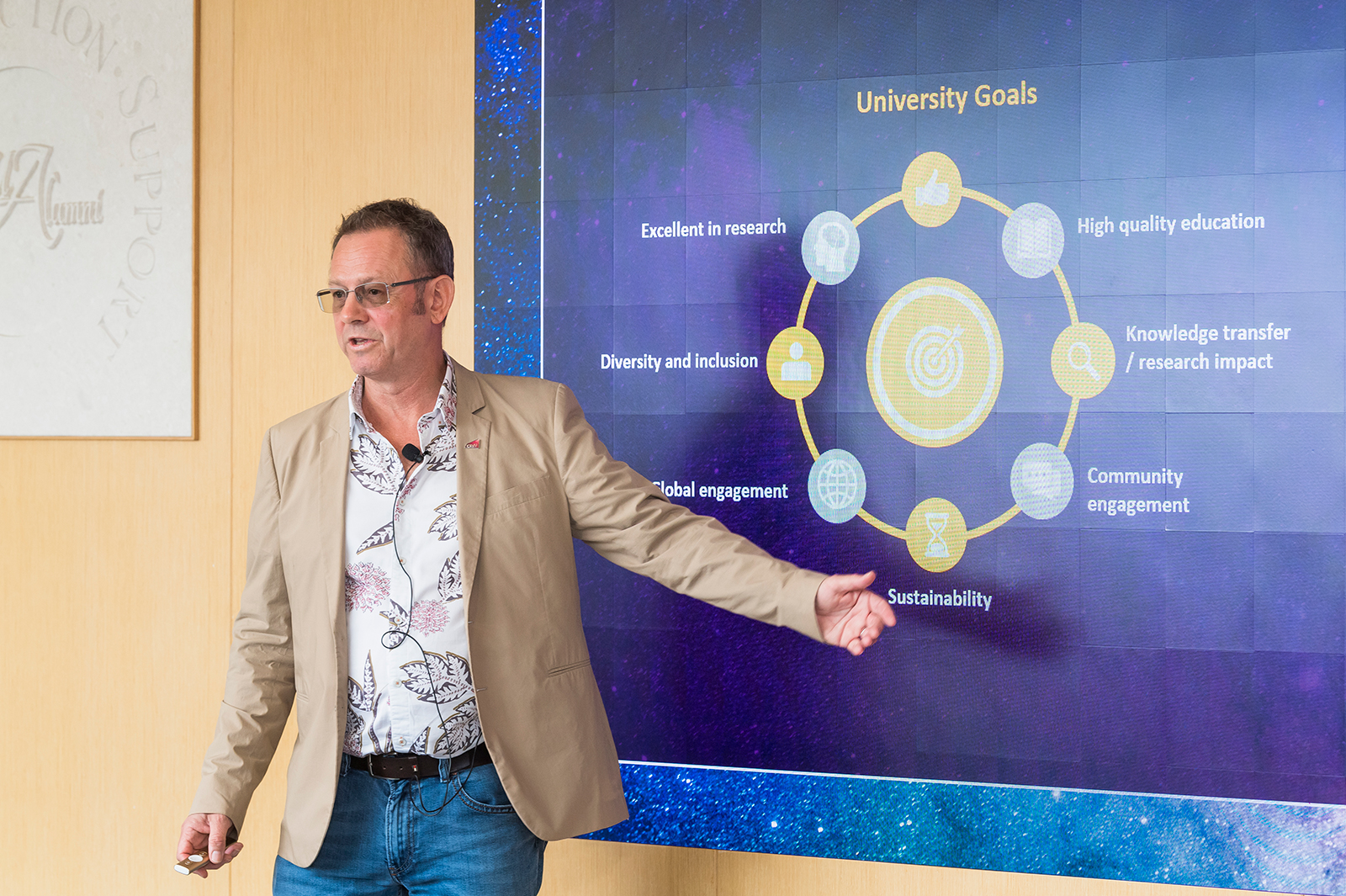
However, while rankings drive certain behaviours, they may not always be aligned with the fundamental values and goals of academic institutions.
To illustrate this point, Professor Walker examined the criteria used in major university rankings, like QS, Times Higher Education, and Academic Ranking of World Universities, noting that while they have evolved to include more diverse metrics, there remain gaps and biases. One example is that they often fail to capture the full spectrum of university goals, such as diversity and inclusion, sustainability and community engagement.
Professor Walker concluded by reminding the audience that ranking is a reductionist approach, which does not adequately capture the complexity of education and knowledge creation. But “rankings are institutionalised,” he said. “We are not getting rid of them. The question is whether we can maintain a balance between the adherence to rankings and pursuing our ‘quest for truth’.”
Professor Walker’s speech inspired an enthusiastic response from the audience, with some noting the evolution of research excellence assessment indices. While acknowledging the advances in the assessment system and the integration of new metrics, Professor Walker raised an important question: Are these changes in assessment criteria driven by the academic community or by the private ranking organisations? He highlighted the challenge of maintaining a balance between striving for higher rankings and upholding the core goals of the university.